
Beyond the Heatwave: How Deep Argo Floats are helping Scientists Track Climate Change in the Deep Ocean
- July 8, 2026
- Category: Testimonies

As heatwaves become more frequent and intense across the globe, understanding how our climate is changing has never been more important. While rising air temperatures often dominate headlines, the atmosphere tells only part of the story.
In fact, the ocean absorbs more than 90% of the excess heat generated by global warming, acting as Earth’s largest climate regulator. To understand how climate change is evolving and what it means for our future, scientists need to monitor not only the ocean surface, but also its deepest and least explored regions.
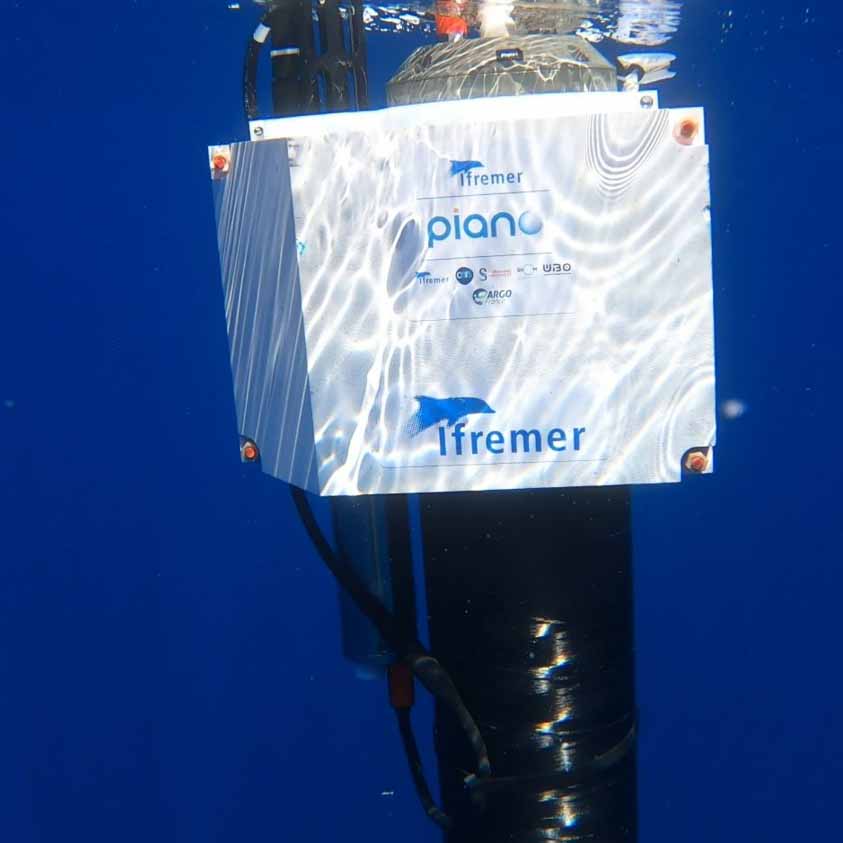
This is precisely the mission of a new generation of Deep Argo floats, named the Abyss-Arvor, developed by Ifremer and NKE Instrumentation, capable of diving autonomously to depths of 6,000 meters.
A New Window into the Abyss
In early 2026, Ifremer successfully completed the first sea trials of two Abyss-Arvor float prototypes in the Caribbean Sea. These autonomous instruments descended to 6,000 meters before returning to the surface and transmitting their observations via satellite to scientists on shore. France now joins the small group of nations capable of designing and operating ocean profiling floats that can explore the abyssal ocean.
The achievement represents a major milestone for the international Argo program, the world’s largest ocean observation network. Since its launch in 2000, Argo has transformed our understanding of the ocean through a fleet of more than 4,000 autonomous profiling floats distributed across the globe.
While traditional Argo floats typically collect measurements down to 2,000 meters, the Deep Argo program extends observations into one of the least monitored regions on Earth: the deep ocean.

Why Measure the Ocean at 6,000 Meters?
For decades, climate scientists have focused primarily on the upper layers of the ocean, where most observations have been collected. However, growing evidence shows that important climate signals are also reaching much deeper waters.
Scientists estimate that approximately 10% of ocean warming occurs below 2,000 meters. Recent observations have even revealed warming trends below 4,000 meters in parts of the Southern Ocean. Understanding how this heat is transported and stored is critical for improving climate predictions and assessing long-term changes to the Earth system.
The new Abyss-Arvor floats provide a unique opportunity to observe these processes directly.
During each ten-day mission cycle, the floats collect measurements of temperature, salinity, oxygen and pressure throughout the water column. These observations help scientists better understand how heat and carbon are stored in the deep ocean, how ocean circulation is evolving, and how these changes influence climate patterns worldwide.
The data will also contribute to a better understanding of sea-level rise, one of the most significant consequences of a warming planet.
Engineering for Extreme Conditions
Operating at 6,000 meters presents enormous technical challenges.
At these depths, pressure reaches nearly 600 times that experienced at the ocean surface. Instruments must withstand these extreme conditions while remaining energy-efficient enough to operate autonomously for years.
To meet these requirements, Ifremer and NKE Instrumentation developed a new generation of profiling floats using advanced composite materials and innovative engineering solutions. Designed to operate for up to seven years, the floats can repeatedly descend into the abyss and return to the surface to deliver their valuable observations.
By 2028, France plans to deploy 30 Abyss-Arvor profiling floats, helping expand global coverage of the deep ocean and contributing to an international effort to monitor more than 98% of the world’s ocean volume.
From the Deep Ocean to Scientists Worldwide
Collecting data in some of the most remote parts of the ocean is only the first step. To support climate research and operational oceanography, observations must be transmitted, secured and made available to scientists around the world in near real time.
As a long-standing partner of the Argo program, CLS contributes to the infrastructure that helps make this possible. As the only company able to provide both ARGOS & IRIDIUM solutions for environmental applications, CLS can provide the right satellite telemetry needed.

For oceanographic platforms using Iridium RUDICS communications, CLS provides a secure hosting service that enables reliable data exchanges between instruments at sea and scientists on land. Originally developed to support Argo operations, this service offers secure data management, active redundancy and high availability to ensure critical observations remain accessible whenever they are needed.
Beyond communications, CLS has supported the Argo program since its early years through data processing, dissemination and operational services that help transform ocean observations into actionable information for the global scientific community.
Understanding Tomorrow’s Climate
The deep ocean remains one of the least explored environments on Earth, yet it plays a fundamental role in regulating the planet’s climate.
As heatwaves and other climate-related events become increasingly visible, the need for accurate and comprehensive ocean observations continues to grow. By extending measurements from the surface to the abyss, Deep Argo floats are helping scientists uncover how climate change is affecting the ocean’s deepest layers and improving our ability to understand, model and anticipate future change.
Because understanding tomorrow’s climate starts with measuring the ocean today.